
01 / THE CONCEPTA closer look
A closer look
at the idea.
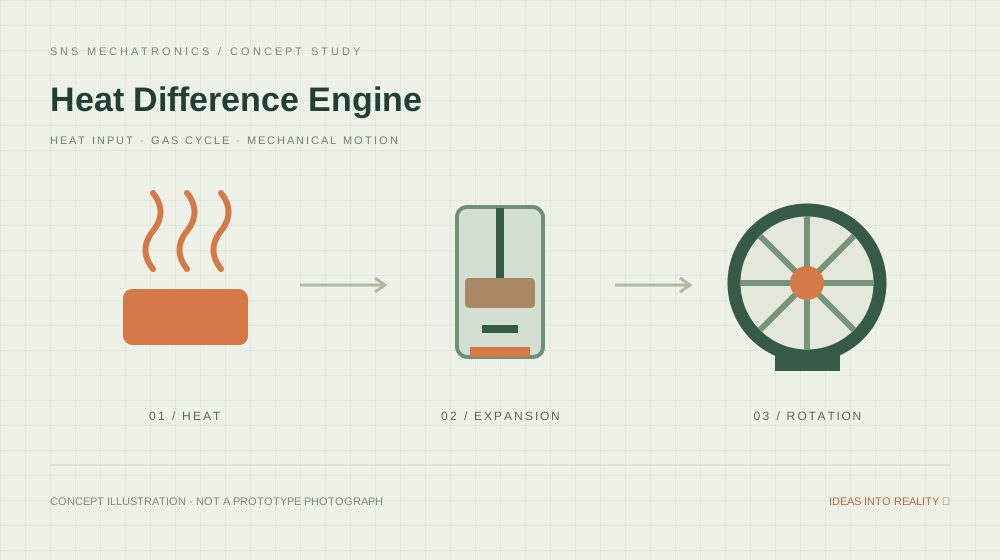
A heat difference engine demonstrates how a temperature difference can be converted into mechanical motion. A Stirling-type model is one way to explore this principle using a working gas that is repeatedly heated and cooled.
How the concept works
In a typical Stirling demonstration, the working gas moves between warmer and cooler regions. Its changing pressure acts on a piston, while a flywheel and linkage help carry the mechanism through its cycle. The engine requires a heat source and a cooler region; it does not create energy without an input.
What you can explore
- Heat transfer and temperature differences
- Gas expansion and compression
- Piston, crank, and flywheel relationships
- Observing friction and heat-loss effects
Applications and project scope
A teaching model for thermodynamics and energy conversion. Output depends on the model, temperature difference, friction, and construction quality; no output-power or efficiency rating is implied by this overview.